DOMS is not random and neither is how to reduce it. This guide covers the biology of muscle soreness, how PBM interrupts the inflammatory cascade, optimal timing (pre vs post training), wavelength selection, and the full recovery protocol.
The PBM Recovery Protocol: What Athletes, Pilates Practitioners and Clinics Need to Know
Recovery is where performance is built. Not during training in the hours that follow. The inflammatory cascade that causes delayed onset muscle soreness (DOMS) is a necessary part of adaptation. But the speed and quality of that process determines how quickly an athlete, patient, or active person can train again, and whether cumulative load turns into progress or injury.
Photobiomodulation (PBM), the application of specific red and near-infrared wavelengths to biological tissue, has accumulated a substantial evidence base in the area of muscle recovery and performance. The mechanisms are fundamentally different from icing, compression, or massage. PBM works at the mitochondrial level, modulating the cellular energy environment during the recovery window in a way that accelerates tissue repair and reduces the inflammatory signal load.
This article sets out the biology, the evidence, the timing question, wavelength selection, and a practical protocol structure for applying PBM in a recovery context whether you are an athlete, a practitioner, or a facility integrating photobiomodulation into a training or longevity programme.
This is especially relevant for movement disciplines where eccentric loading is structural,not incidental. Reformer Pilates involves repeated controlled eccentric contractions across every session. Practitioners training three to five times per week accumulate significant eccentric load at high frequency, creating an environment where recovery speed directly determines the quality of the next session.
Why muscles get sore, the biology of DOMS
Delayed onset muscle soreness is a well-understood physiological phenomenon, but its name understates its relevance to training. DOMS is not just discomfort it is a direct limiter of training frequency, movement quality, and recovery speed.
When exercise, particularly eccentric contractions, which define both traditional strength training and reformer Pilates movements, loads a muscle beyond its current adaptation capacity, microscopic tears form in the muscle fibres. This structural disruption triggers a cascade:
- Damaged muscle cells release proteins into the bloodstream: creatine kinase (CK) is the primary measurable marker of this damage and is widely used in research to quantify exercise-induced muscle injury
- Immune cells, monocytes and macrophages, accumulate at the injury site and begin the repair process
- As part of the inflammatory response, prostaglandins are produced at elevated levels
- These prostaglandins activate type III and IV pain receptors within 24–48 hours, producing the characteristic sensation of DOMS
DOMS typically peaks between 24 and 72 hours post-exercise and resolves within 5–7 days in untrained or recently deconditioned individuals. In an active training context, this window directly limits how frequently a muscle group can be trained and at what quality.
The goal of any recovery intervention is not to eliminate the inflammatory response, the stimulus for adaptation depends on it, but to modulate its duration and severity so that the adaptation cycle completes faster without prolonging the damage phase unnecessarily.
How photobiomodulation interrupts the recovery cycle
PBM does not suppress the inflammatory response in the way NSAIDs do. It modulates the cellular environment so that the repair process proceeds faster and with less unnecessary inflammatory load. The primary mechanism operates at the mitochondrial level. [1]
The key target is cytochrome c oxidase (CCO) complex IV of the mitochondrial electron transport chain. CCO has multiple absorption peaks across the red and near-infrared spectrum. When photons at the right wavelengths interact with CCO, they temporarily dissociate nitric oxide inhibition of the enzyme, restoring oxygen consumption and accelerating ATP production. Cells under repair, metabolically active, energy-demanding, suddenly have more energy substrate to work with. The downstream consequence is a cascade of effects that modulate the recovery environment. [1]
What PBM does at the cellular level:
- Increases mitochondrial ATP production via CCO activation
- Reduces reactive oxygen species (ROS): attenuating oxidative stress load
- Downregulates pro-inflammatory cytokines including TNF-α and IL-1β
- Accelerates clearance of creatine kinase from the bloodstream (reduced muscle damage load)
- Stimulates fibroblast activity and tissue regeneration
These are not sequential steps they happen concurrently across irradiated tissue during and immediately after a session.
A 2018 meta-analysis by Machado et al. confirmed that phototherapy has significant beneficial effects on creatine kinase activity, the primary blood marker of exercise-induced muscle damage, with effect sizes larger in studies using localised exercise protocols. [2]
A 2025 systematic review and Bayesian network meta-analysis by Chen et al. found that PBM produces significant effects on DOMS within the first 48-hour window — precisely the period when inflammation and pain are typically at their peak and training capacity is most impaired. [3]
Before or after training? The timing question
The research is clear: both. Pre- and post-exercise PBM produce distinct but complementary effects. The most clinically significant improvements come from combining both windows.
A 2018 randomised controlled trial by Miranda et al. examined the effect of PBMT applied before training, after training, both, or neither, across a 12-week endurance programme in healthy volunteers. The group receiving PBMT both before and after each session showed significantly greater improvements in time-to-exhaustion and oxygen uptake, and reached those improvements three times faster than the exercise-only group. Reductions in body fat were also significantly greater in the combined group at 8 and 12 weeks. [4]
Pre-exercise: muscular preconditioning
Applying PBM before a training session prepares the mitochondrial environment before mechanical load is applied. A 2016 study by Vanin et al. investigated optimal pre-exercise dosing using 810nm laser therapy on skeletal muscle performance and post-exercise recovery. The study identified a dose-dependent relationship between pre-irradiation and post-exercise CK levels and recovery outcomes, suggesting that pre-exercise PBM acts as a physiological preparation rather than just a reactive intervention. [5]
The practical implication is that pre-exercise application reduces the magnitude of muscle damage produced by the same training load, not by blocking the training stimulus, but by preparing cellular energy availability before the load is applied.
Post-exercise: the recovery window
Post-exercise application is the most extensively studied timing in the DOMS literature and the most practically accessible for most athletes and facilities. Borges et al. (2014) applied 630nm LED therapy immediately after a damaging eccentric exercise bout in a randomised, double-blind, placebo-controlled trial. Muscle soreness, strength loss, and range of motion impairment were all significantly reduced up to 96 hours post-exercise in the treated group compared to placebo, with a single application. [6]
The 96-hour effect duration is clinically significant: it covers the full standard DOMS window. A single post-exercise session attenuated not just acute pain but the functional impairment, strength and range of motion, that directly limits training quality in the days following an intense session.
Timing protocol recommendation:
- Priority: post-exercise (within 30 minutes of training completion)
- Optimal: pre- and post-exercise on moderate-high intensity training days
- Minimum commitment: post-session use 3x/week during active training blocks
- Duration: 10–20 minutes per session (full-body or targeted to trained muscle groups)
See how red light supports your goals - explore the product benefits now.

Wavelength selection for muscle recovery
Not all wavelengths contribute equally in the recovery context. The evidence base is concentrated in two primary ranges, with a third extending the application to connective tissue and joint-adjacent recovery.
630–660nm (Red light): Primarily affects surface tissue: skin, dermis, superficial circulation, and the superficial layer of muscle. Stimulates fibroblast activity, local circulation, and the inflammatory signalling cascade at the skin and surface muscle layer. Borges et al. demonstrated that a single session of 630nm LED therapy was sufficient to produce significant recovery benefits up to 96 hours after eccentric exercise. [6]
810–850nm (Lower NIR): The primary wavelength for deep skeletal muscle tissue. Strong affinity for CCO activation in deep muscle, anti-inflammatory signalling, and reduction of oxidative stress at depth. The most evidence-supported wavelength in the PBM muscle recovery literature. Pre-exercise dosing at 810nm has been shown to produce dose-dependent protective effects on muscle damage markers. [5]
1060nm (Higher NIR): Primarily targets lipid-rich tissue: adipose tissue and cartilage matrix. In a recovery context, this is particularly relevant for joint-adjacent recovery: the cartilage, connective tissue, and lipid-rich structures surrounding loaded muscle groups. For athletes working on body composition simultaneously, 1060nm adds a distinct target that neither red light nor standard NIR addresses. Its role is complementary, it extends a full-spectrum protocol to tissue that 630nm and 810nm do not reach with the same specificity.
The Luminous Labs Recovery Protocol
Based on the current evidence base for photobiomodulation in muscle recovery and athletic performance.
Session parameters:
- Timing: immediately post-exercise (within 30 min). Add pre-session if time allows.
- Duration: 10–20 minutes full-body exposure
- Primary wavelength: 810–850nm — deep muscle, CCO activation, anti-inflammatory
- Supporting wavelength: 630–660nm — surface repair, circulation, fibroblast activation
- Extended protocol: + 1060nm for joint-adjacent recovery, connective tissue, body composition
- Positioning: minimal clothing — direct skin contact for unfiltered photon delivery
Training block frequency:
- Active training block (3–5 sessions/week): post-session use after every moderate-high intensity training day
- For Pilates practitioners: post-session use after every reformer class, with pre-session application on high-intensity days.
- Maintenance / lower intensity weeks: minimum 3x/week
- Recovery weeks: daily use optional, recovery applications support cellular regeneration even in the absence of acute muscle damage
Note: Consistency is the primary variable that differentiates results in the literature. Single sessions produce effects. Repeated sessions across a training block compound them.
Frequently asked questions
Does red light therapy help muscle recovery?
Yes. Consistent evidence from randomised controlled trials shows that photobiomodulation reduces DOMS, accelerates strength return, improves range of motion recovery, and lowers blood markers of muscle damage (creatine kinase) following exercise. A 2025 meta-analysis confirmed significant effects within the 48-hour post-exercise window, the period when inflammatory pain and functional impairment are typically at their peak.
What wavelength is best for muscle recovery?
810–850nm is the primary wavelength for deep skeletal muscle recovery, it has the strongest affinity for cytochrome c oxidase activation in muscle tissue and the most evidence for DOMS reduction and anti-inflammatory effects. 630–660nm adds a surface-level effect on circulation and fibroblast activation. A combined protocol using both wavelengths covers the full recovery window. For joint-adjacent recovery and connective tissue, 1060nm extends the protocol further.
How long after training should I use red light therapy?
Immediately after training is optimal, within 30 minutes of session completion. Borges et al. (2014) applied 630nm LED therapy directly post-exercise and found significant reductions in soreness, strength loss, and range of motion impairment for up to 96 hours from a single application. The post-exercise window, when cells are metabolically active and repair processes are initiating, is when PBM has the highest impact.
Is it better to use red light therapy before or after a workout?
Both produces the best outcomes. Miranda et al. (2018) demonstrated that PBMT applied both before and after endurance training sessions improved time-to-exhaustion and oxygen uptake three times faster than exercise alone. Pre-exercise application acts as muscular preconditioning, reducing the magnitude of damage from the training load. Post-exercise application accelerates the repair and inflammation resolution that follows. If only one window is available, post-exercise is the higher priority.
How often should I use photobiomodulation for recovery?
For active training blocks, post-session use after every moderate-high intensity training day is the evidence-supported approach, typically 3–5 sessions per week. This aligns PBM application with training frequency naturally. During recovery weeks or lower-intensity periods, a minimum of 3 sessions per week maintains the cellular repair environment. Consistency across a training block compounds the effects.
What is the best PBM protocol for athletes?
The optimal protocol combines 810–850nm and 630–660nm wavelengths, delivered via full-body exposure for 10–20 minutes, applied both before and after training sessions. For athletes with joint load, connective tissue demands, or body composition goals, extending the protocol to include 1060nm adds tissue targets that shorter wavelengths do not reach. The single most important variable in the research is not wavelength selection but consistency of application across the training block.
Does PBM work for Pilates recovery?
Yes. The recovery mechanisms are identical. PBM targets the same DOMS biology regardless of whether the eccentric load came from a squat rack or a reformer carriage. Pilates involves repeated controlled eccentric contractions across every session, making it a high-frequency eccentric loading environment. For practitioners training three to five times per week, recovery speed directly limits training quality. A post-session protocol, 10–20 minutes at 810–850nm and 630–660nm, applied immediately after class addresses both the deep muscle fatigue and the surface-level inflammation that accumulates across a Pilates training week. House of IKKI in Vienna is one of the first studios to integrate a clinical-grade PBM recovery protocol alongside its reformer programme.
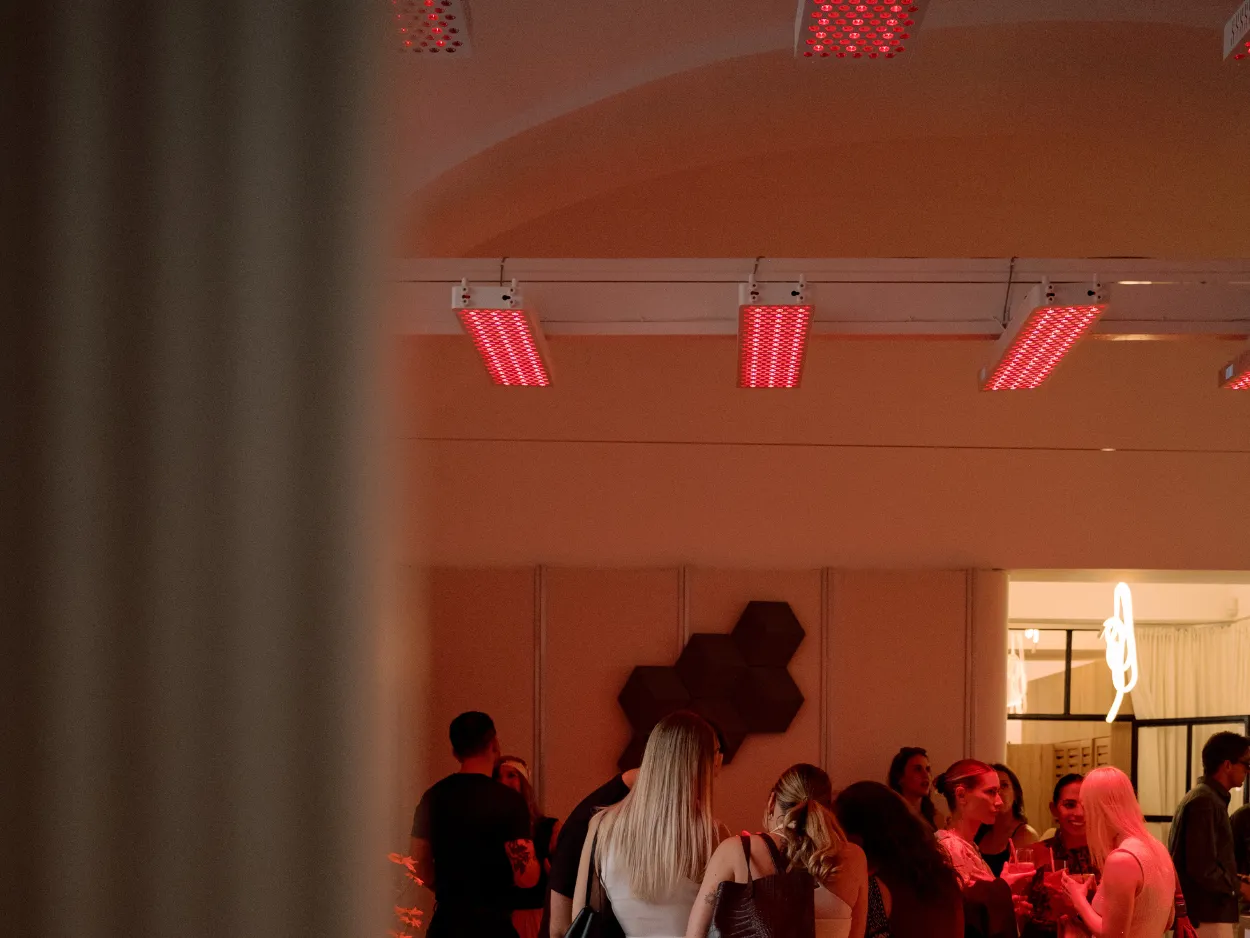
PBM is now available as a structured recovery protocol at House of IKKI in Vienna, integrated directly into the studio's reformer Pilates environment. Sessions are delivered via CellLight™ panels, with dosage controlled through the Redgevity Master platform, which calibrates wavelength, intensity, and duration to individual protocols across up to ten panels simultaneously. For practitioners and facility managers exploring a clinical-grade recovery integration, the full protocol framework is available at redgevitymaster.com.
References
[1] Ferraresi, C., Huang, Y.Y., Hamblin, M.R. (2016). Photobiomodulation in human muscle tissue: an advantage in sports performance? Journal of Biophotonics.
[2] Machado, A.F. et al. (2018). Phototherapy on Management of Creatine Kinase Activity in General Versus Localized Exercise: A Systematic Review and Meta-Analysis. Lasers in Medical Science. [Confirm PubMed link before publishing]
[3] Chen, J. et al. (2025). Differences in the Effectiveness of Different Physical Therapy Modalities in the Treatment of Delayed-Onset Muscle Soreness: A Systematic Review and Bayesian Network Meta-Analysis.
[4] Miranda, E.F. et al. (2018). When is the best moment to apply photobiomodulation therapy (PBMT) when associated to a treadmill endurance-training program? A randomized, triple-blinded, placebo-controlled clinical trial. Lasers in Medical Science.
[5] Vanin, A.A. et al. (2016). Pre-Exercise Infrared Low-Level Laser Therapy (810 nm) in Skeletal Muscle Performance and Postexercise Recovery in Humans, What Is the Optimal Dose? A Randomized, Double-Blind, Placebo-Controlled Clinical Trial. Photomedicine and Laser Surgery.
[6] Borges, L.S. et al. (2014). Light-emitting diode phototherapy improves muscle recovery after a damaging exercise. Lasers in Medical Science.