By the end of September, Vienna gets around 12 hours of daylight. By October it's closer to 10. By December, just under 9. This isn't a minor shift, it's a structural change in the light environment your biology has been calibrated to since birth. And most people feel it before they understand it: lower energy, heavier mornings, a flattening of mood that arrives quietly and stays until March. Red light therapy doesn't fix seasonal change. But autumn is when a calibrated, consistent practice matters most and when most people get it wrong.
What Actually Changes in Autumn
The mechanism worth understanding is not sunlight in general, but the specific consequences of reduced morning light intensity.
Your circadian rhythm, the internal biological clock governing sleep, cortisol, energy, and dozens of downstream hormonal processes, is primarily entrained by bright light exposure in the morning hours. As days shorten in autumn, that morning light signal arrives later, at lower intensity, and at an angle that reduces its biological potency. The result isn't just feeling a bit tired. It's a measurable shift in cortisol timing, melatonin duration, and the metabolic rhythm that determines how energised you feel throughout the day.
Separately, reduced daylight means less time outdoors, which means less physical movement. Less movement means reduced mitochondrial demand and mitochondria that aren't regularly stimulated do exactly what any system does when demand drops: they downregulate. Cellular energy production declines. The symptoms feel familiar: fatigue, slower recovery, brain fog.
These two forces, disrupted light signalling and reduced mitochondrial activity, compound each other across autumn and winter. They also compound behavioural patterns: lower energy leads to less motivation to maintain the practices that would help. The people who sustain their performance through autumn are the ones who treat October the same way they treat June.
Where Red Light Fits and Where It Doesn't
It's worth being precise here, because the red light category often overclaims.
Red and near-infrared light (630–850nm) is not the primary driver of your circadian clock. That distinction belongs to blue and white light in the 460–480nm range. A red light session will not substitute for bright morning light exposure in terms of circadian resetting. If you're looking for seasonal light therapy in the clinical sense,. the kind used to manage Seasonal Affective Disorder, you need a broad-spectrum bright light device, not a red light panel.
What red light does, with strong and growing clinical evidence, is support mitochondrial function directly. Near-infrared wavelengths (particularly 850nm) are absorbed by cytochrome c oxidase (CCO), the terminal enzyme in the mitochondrial electron transport chain. This absorption drives increased ATP production: more cellular energy, available more readily. The anti-inflammatory signalling that follows compounds these effects over consistent sessions.
This is precisely why autumn matters for red light practice. When your mitochondria are under-stimulated from reduced movement and your circadian inputs are weakened by shorter days, a calibrated red light session becomes one of the most direct tools available for maintaining cellular energy output. Not by replacing what the season removes, by working through a different mechanism entirely to support what remains.

Why Frequency Matters More in Autumn Than in Summer
The research on photobiomodulation frequency is unambiguous: 3–5 sessions per week, sustained over weeks, is where meaningful outcomes compound. Below that threshold, you're resetting rather than accumulating.
In summer, maintaining frequency is relatively effortless. Morning routines anchor around outdoor activity. Energy is higher. The motivation to maintain a practice is externally reinforced by light, temperature, and schedule.
Autumn removes those external cues. The session you were doing every morning becomes the session you're "going to start again next week." This is where the gap between results and no results opens up, not in the parameters of any given session, but in the decision to keep showing up.
A Protocol matters in autumn specifically because it reduces that friction. When you have a specific plan, your indication, your dose target, your session structure calibrated to your device, you're not deciding whether to do red light therapy. You're executing a protocol that already exists. The activation energy is lower. The consistency follows.
The Seasonal Argument for Calibration
There's one more reason autumn raises the stakes on protocol quality.
In summer, it's easier to absorb the cost of a sub-optimal session. Energy levels are higher, natural inputs are supportive, and the margin for imprecision is wider. Autumn closes that margin.
If your sessions have been running below therapeutic irradiance (below 50 mW/cm² at your usage distance) you haven't been receiving the biological signal the research describes. In summer, this might go unnoticed because other factors are compensating. In autumn, when those compensating factors are withdrawn, the absence of a genuine therapeutic signal becomes more apparent.
This is the argument for not only maintaining your practice in autumn, but making sure what you're doing is actually calibrated. The right wavelengths for your indication. The right dose for your device. The right frequency for your goals. Not a generic routine, a plan.
See how red light supports your goals - explore the product benefits now.
A September Practice
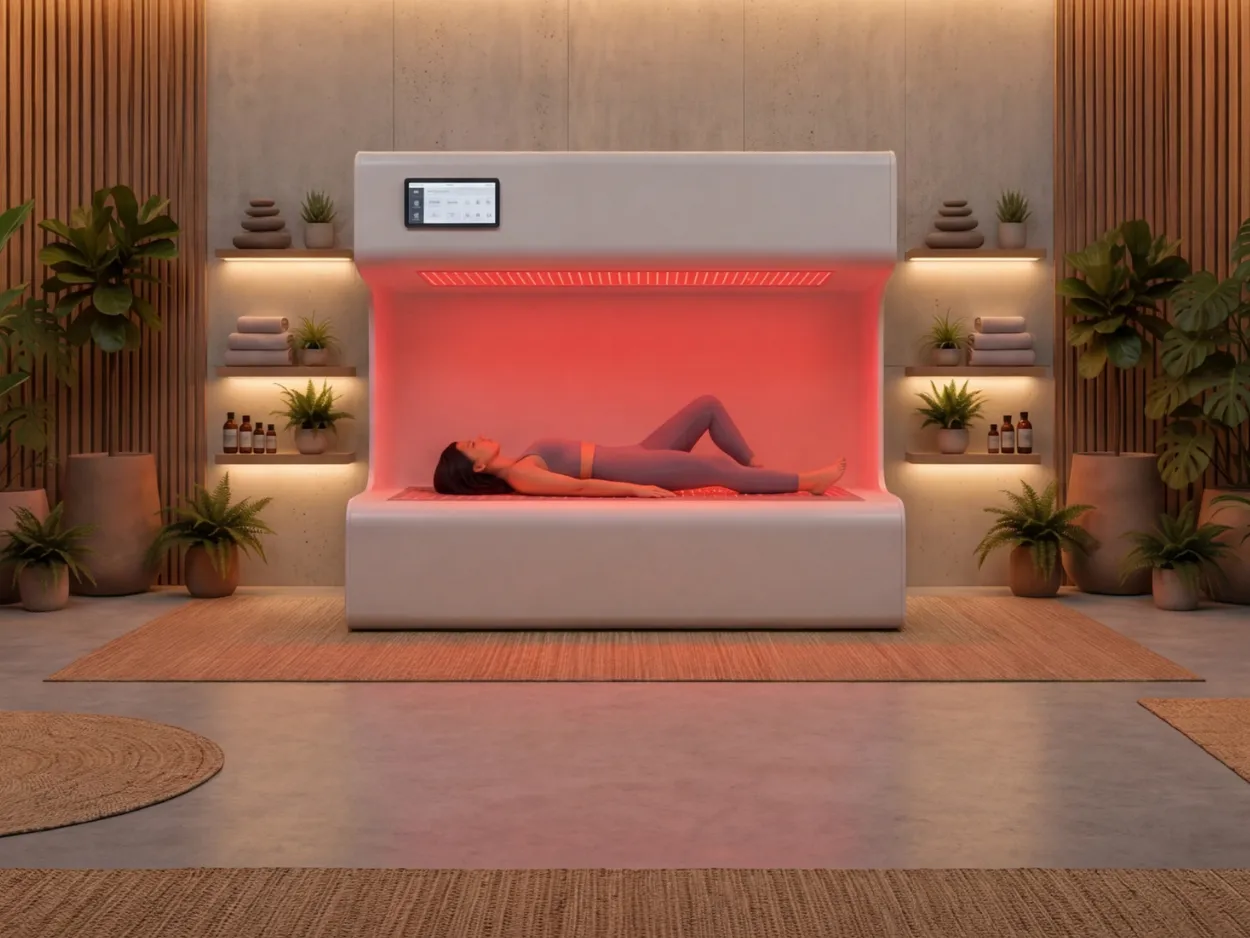
For autumn, we recommend building toward 4–5 sessions per week across October. The structure matters less than the consistency.
Weeks 1–2: Establish 3 sessions per week. Morning sessions are convenient but not biologically mandated, what matters is that you choose a time you can repeat. Consistency beats timing.
Weeks 3–4: Add one session. The compounding effect of PBM requires sustained frequency. Four sessions per week through October and November is where the difference between summer and winter performance begins to close.
Focus for the season: 850nm for cellular energy and deep tissue support. 660nm for skin, which loses natural UV stimulus significantly as autumn progresses. If you have access to 1060nm (Pro Series or RGM) this is the season to use it for joint warmth and deep tissue support as temperatures drop.
If you're on a Luminous Protocol, run it as specified. The Protocol already accounts for your device and your indication, autumn is when you need it most, not when you vary from it.
Frequently Asked Questions
Is red light therapy effective in autumn and winter? Yes! and more consistently useful than in summer for many people. Autumn reduces natural light stimulus and outdoor activity, both of which affect cellular energy and circadian rhythm. Red light (630–850nm) supports mitochondrial ATP production through a direct mechanism that operates independently of sunlight. A consistent red light practice in autumn helps maintain cellular energy output when environmental inputs are declining.
What is the difference between red light therapy and SAD light therapy? SAD (Seasonal Affective Disorder) light therapy uses broad-spectrum bright white light at high lux to simulate morning daylight and reset the circadian clock. It targets blue-light-sensitive pathways. Red light therapy (photobiomodulation) works through a different mechanism, near-infrared absorption in cytochrome c oxidase in the mitochondria, and is not a replacement for SAD light therapy. Both can be part of an autumn health protocol, but they address different biological systems.
How often should I do red light therapy in autumn? (Rotlichttherapie Herbst Häufigkeit) Research consistently shows 3–5 sessions per week as the frequency range where photobiomodulation effects compound meaningfully. In autumn, maintaining this frequency is more important than in summer precisely because natural compensating inputs, outdoor light, higher activity, are reduced. Fewer sessions per week means resetting rather than accumulating.
Why is a protocol more important in autumn? (Rotlicht Herbst Protokoll) A calibrated protocol reduces the friction of maintaining consistent practice when motivation is externally lower. It also ensures your sessions are operating at therapeutic irradiance, 50 mW/cm² or above at your usage distance, and at the wavelengths appropriate for your indication. In summer, sub-optimal sessions are easier to absorb because other factors compensate. In autumn, the margin for imprecision is narrower.
Does red light help with autumn fatigue and low energy? (Herbstmüdigkeit Rotlichttherapie) Red light supports mitochondrial ATP production, which is the cellular mechanism underlying energy availability. This is not a medical claim for treating seasonal fatigue as a diagnosed condition, but for people experiencing the energy decline that commonly accompanies shorter days and reduced outdoor activity, maintaining a consistent, calibrated red light practice addresses the mitochondrial side of that equation directly.
What wavelength should I focus on in autumn? 850nm for deep tissue mitochondrial support and cellular energy. 660nm for skin, which loses significant UV stimulus in autumn. 1060nm (available in the Pro Series and RGM) for joint and adipose tissue support as temperatures drop. The Luminous Protocol specifies the right wavelength combination and dose for your device and indication.
Your Protocol Is Your Autumn Plan
Autumn is when most people quietly let their health practices slip and feel the consequences of that slip three months later, in the dead of winter.
The Protocol isn't a summer tool. It's a year-round calibration system that matters most when conditions are working against you. If you haven't started yours, September is the best month to do it.
Sources
Friborg O, et al. Annual variation in daily light exposure and circadian change of melatonin and cortisol concentrations at a northern latitude with large seasonal differences in photoperiod length. Chronobiol Int. 2016.
Shanahan TL, Czeisler CA. Seasonal variation in the human circadian rhythm: dissociation between sleep and temperature rhythm. Am J Physiol. 1991.
Karu TI. Multiple roles of cytochrome c oxidase in mammalian cells under action of red and IR-A radiation. IUBMB Life. 2010;62(8):607–610.
Karu TI, Kolyakov SF. Exact action spectra for cellular responses relevant to phototherapy. Photomed Laser Surg. 2005;23(4):355–361.
Hamblin MR. Mechanisms and Mitochondrial Redox Signaling in Photobiomodulation. Photochem Photobiol. 2018;94(2):199–212.
Glickman G, et al. Light therapy for seasonal affective disorder with blue narrow-band light-emitting diodes (LEDs). Biol Psychiatry. 2006;59(6):502–507.
Campbell PD, et al. Bright Light Therapy: Seasonal Affective Disorder and Beyond. Einstein J Biol Med. 2017;32:E13–E25.
Ferraresi C, et al. Photobiomodulation Therapy on Physiological and Performance Parameters During Running Tests: Dose-Response Effects. Photomed Laser Surg. 2018;36(6):312–320.
Zein R, et al. Exploring the biphasic dose-response effects of photobiomodulation therapy. Photomed Laser Surg. 2024.