Is photobiomodulation evidence-based enough for clinical investment? Honest answers to the 5 questions every clinic, spa and hotel asks before adopting PBM.
The 5 Questions Every Clinic Asks Before Investing in PBM
More clinic directors, spa managers and wellness practitioners are asking about photobiomodulation. The questions have changed. A few years ago the question was: does it work? Today the question is: is it worth the investment, and how do we do it properly?
That is a better question. And it deserves a better answer than most suppliers give.
Below are the five questions we hear most often before an operator makes a PBM decision. We have answered them as directly as we can, including the ones where the honest answer is more complicated than a sales conversation tends to allow.
1. Is the clinical evidence actually strong enough to justify this?
Yes: but the question needs unpacking.
Photobiomodulation has over 6,000 published studies behind it. The foundational mechanisms are well-established: red and near-infrared light activates cytochrome c oxidase in mitochondria, increasing ATP production, modulating inflammation, and triggering downstream cellular responses. [1, 2]
The evidence is strongest in specific applications: skin rejuvenation and collagen synthesis, muscular recovery and reduced delayed onset muscle soreness, wound healing, and anti-inflammatory effects. These are not fringe applications, they are the most studied, with multiple randomised controlled trials in peer-reviewed journals.
The honest nuance: evidence quality varies significantly by indication and by study design. Not every claim made in the PBM market is supported by the same level of evidence. Any supplier who tells you the evidence is uniformly strong across all applications is oversimplifying.
What the evidence does support clearly: when the wavelength is correct, the dose is appropriate, and the protocol is consistent, photobiomodulation produces measurable, reproducible outcomes in the indications above.
The real risk is not insufficient evidence.
It is insufficient protocol. A well-evidenced treatment applied without structure produces inconsistent outcomes. That is not a failure of the science, it is a failure of implementation.
2. What results can clients realistically expect, and in what timeframe?
This depends entirely on the indication and the protocol. Here is what the evidence actually shows:
Skin: collagen, texture, rejuvenation:
Measurable increases in intradermal collagen density and improvements in skin texture have been documented after 8–12 weeks of consistent application (4–5 sessions per week). Earlier improvements in skin radiance and hydration are typically reported within 4–6 weeks. [3]
Muscular recovery and performance:
Studies show reductions in delayed onset muscle soreness and faster strength recovery when PBM is applied before or after physical exertion. Acute effects are measurable within 24–48 hours of application. Cumulative benefits compound with consistent use. [4, 5]
Anti-inflammatory and pain:
Some clients report effects within the first 1–3 sessions; consistent improvement follows with regular use over 4–8 weeks. [2]
The framework that matters most for clinical operators: a single session has value, but PBM is fundamentally a cumulative intervention. A client who completes 3 sessions has a categorically different experience from one who completes 12 over 3 months. The business and clinical model needs to be built around this reality not around single-session pricing.
3. How does PBM integrate into an existing treatment menu?
More flexibly than most operators expect, but it requires deliberate structure. There are three models that work:
Model 1: Standalone treatment.
Dedicated session, 20–30 minutes, premium positioning. Works well in aesthetics clinics, longevity centres and medical wellness settings. High perceived value when the science is communicated well.
Model 2: Add-on to existing services.
Before or after massage, physiotherapy, pilates or aesthetic treatments. Lower barrier to adoption, good for introducing clients to PBM. Revenue uplift without restructuring the core menu.
Model 3: Protocol continuation programme.
Studio or clinic experience followed by a personalised home protocol then return visits for reassessment and progression. The most commercially interesting model and the most clinically meaningful. Creates retention, recurring revenue, and genuine long-term client outcomes.
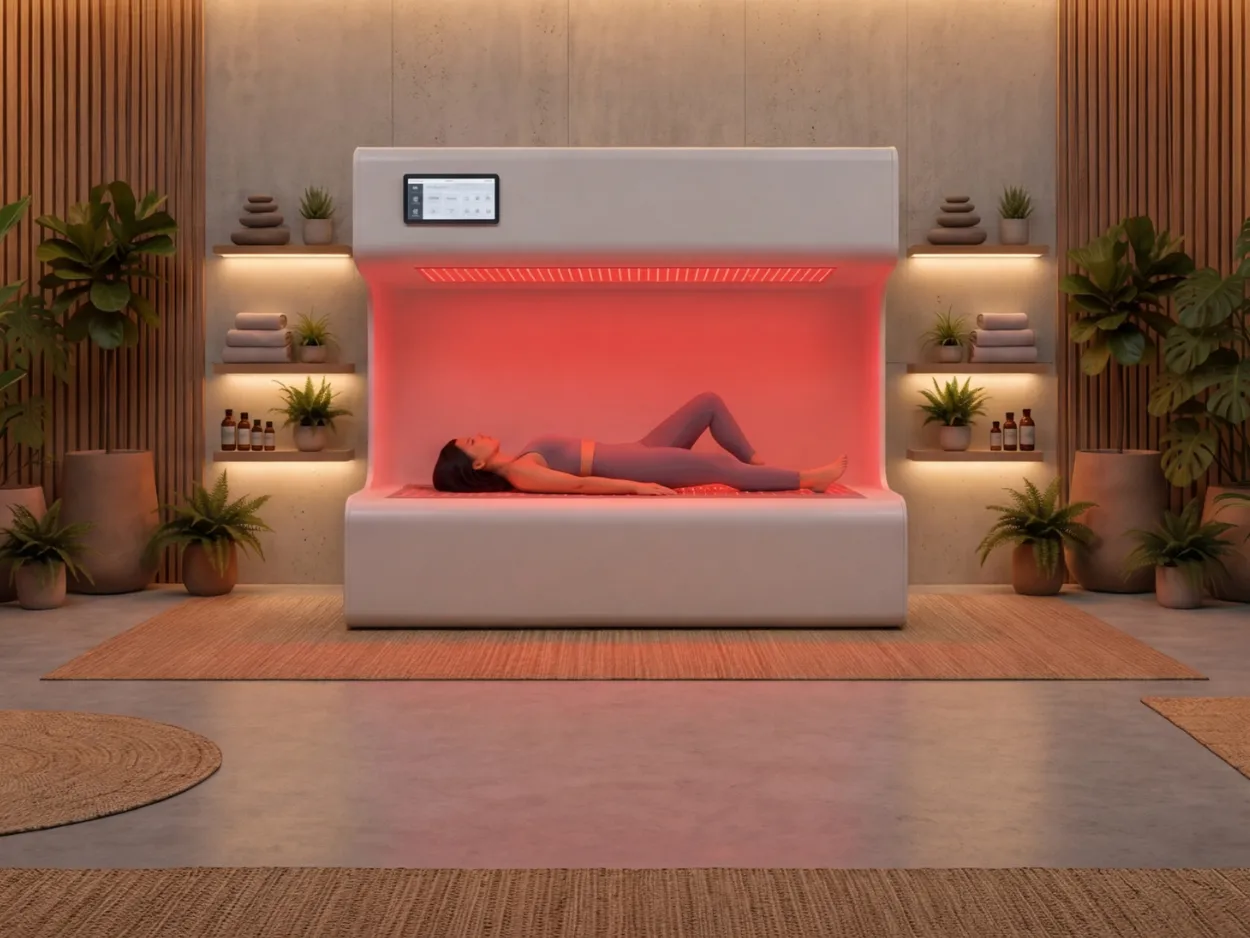
Most operators implement Model 1 or 2 and leave Model 3 on the table. Model 3 is where Redgevity Master is designed to operate, it creates a structured bridge between the in-clinic experience and what happens at home, which is where the majority of real-world protocol hours are logged.
4. What does day-to-day operation look like: training, safety, maintenance?
Staff training.
PBM has a lower technical barrier than most clinical devices, but the training that matters is not device operation, it is protocol knowledge. Learning the device takes hours. Understanding how to apply the right parameters to the right client goal takes longer, and it is what separates consistent outcomes from inconsistent ones. Ask any supplier: do they provide protocol education alongside equipment, or just a user manual?
Safety and contraindications.
For wellness-grade PBM applications, the contraindication list is relatively short: active or suspected malignancy in the treatment area, photosensitising medications, active epilepsy triggered by flashing light (only relevant for pulsed modes), and pregnancy (precautionary, not contraindicated by direct evidence). A professional intake process and a structured contraindication screening protocol are standard practice and provide both clinical safety and liability protection.
Regulatory considerations.
In most European wellness and spa environments, PBM devices used for non-medical indications (recovery, skin wellness, relaxation) do not require medical licensing or physician oversight. This varies by country and application, always verify with a local regulatory expert before clinical claims are made in marketing materials.
Maintenance.
LED-based PBM devices have operational lifespans of 50,000+ hours. Day-to-day maintenance is low: regular cleaning of panels, cable management, periodic device positioning checks, and firmware/software updates for IoT-connected systems.
The question to ask every supplier: beyond the hardware, what infrastructure do they provide for protocol management, client tracking, and ongoing practitioner support?
5. What makes Redgevity Master different?
We built Redgevity Master because we kept seeing the same gap in the market: operators with good devices and no protocol infrastructure. A premium piece of hardware sitting in a room with no structured approach behind it.
Redgevity Master is not a B2B device. It is a B2B platform.
What that means in practice:
- IoT-based personalised protocols delivered via touchscreen interface — the right parameters for each client, not a one-size-fits-all session
- Ongoing practitioner education built into the platform: protocol knowledge, not just device operation
- Luminous Protocol™ integration: a direct bridge from in-clinic experience to personalised home use, with structured continuation and return visit logic
- Built in collaboration with Biogena, one of Europe's most respected evidence-based supplement brands. Nutrition and supplementation protocols that support PBM outcomes are part of the same ecosystem
- Designed specifically for clinic, spa and hotel environments,. not consumer hardware adapted for professional use
The metric we care about is not first-session satisfaction. It is client retention and outcome consistency. A client who has one great experience and never returns has not been well served, and neither has the business.
Redgevity Master is designed around the clinical reality that PBM produces its best outcomes through consistency, personalisation and a structure that extends beyond the session.
See how red light supports your goals - explore the product benefits now.

The Bottom Line
PBM is not a trend. The evidence is real, the mechanisms are documented, and the clinical applications are expanding. But the gap between a device in a room and a protocol that produces consistent, measurable outcomes for your clients is a real gap, and it is where most implementations fall short.
The right question before investing is not only: is the evidence strong enough? It is: does this supplier give me the infrastructure to use it properly?
Frequently Asked Questions
Is photobiomodulation evidence-based?
Yes. Photobiomodulation has over 6,000 published studies and well-documented mechanisms of action — primarily the activation of cytochrome c oxidase in mitochondria, which increases ATP production and modulates cellular activity. The evidence is strongest for skin rejuvenation, muscular recovery, wound healing, and anti-inflammatory applications.
What ROI can a clinic or spa expect from photobiomodulation?
ROI depends on the implementation model. Operators running protocol continuation programmes, where in-clinic sessions connect to personalised home use report the strongest client retention and revenue-per-client metrics. Single-session pricing models have lower retention. The investment case is strongest when PBM is positioned as a protocol, not a treatment.
What training does staff need for photobiomodulation?
Device operation training is minimal, typically a few hours. The training that drives outcomes is protocol knowledge: understanding which parameters apply to which client goals, contraindication screening, and how to communicate the protocol rationale to clients. Redgevity Master includes practitioner education as part of the platform.
What are the contraindications for PBM in a wellness setting?
The main contraindications for wellness-grade PBM are: active or suspected malignancy in the treatment area, photosensitising medications, active light-triggered epilepsy, and pregnancy (precautionary). A structured intake and contraindication screening process is standard practice.
What makes Redgevity Master different from other B2B PBM solutions?
Redgevity Master is a B2B platform, not a B2B device. It includes IoT-based personalised protocol delivery via touchscreen, the Luminous Protocol™ bridge from in-clinic to home use, practitioner education, and the combined scientific infrastructure of Luminous Labs and Biogena. It is designed specifically for clinical and premium wellness environments.
References