
810nm and 1060nm are both near-infrared, but they behave very differently in tissue. 1060nm selectively absorbs into lipids and cartilage in ways that 810nm cannot replicate. Here is what the science shows.
Not All NIR Is Equal: What 1060nm Does That 810nm Doesn't
Same family. Different tissue target.
Most conversations about red light therapy centre on two wavelength ranges: red at 630–660nm and near-infrared at 810–850nm. These are the most studied, the most validated, and the most present in both consumer and clinical devices. The mechanisms are well established, cytochrome c oxidase activation, ATP production, fibroblast stimulation, anti-inflammatory signalling.
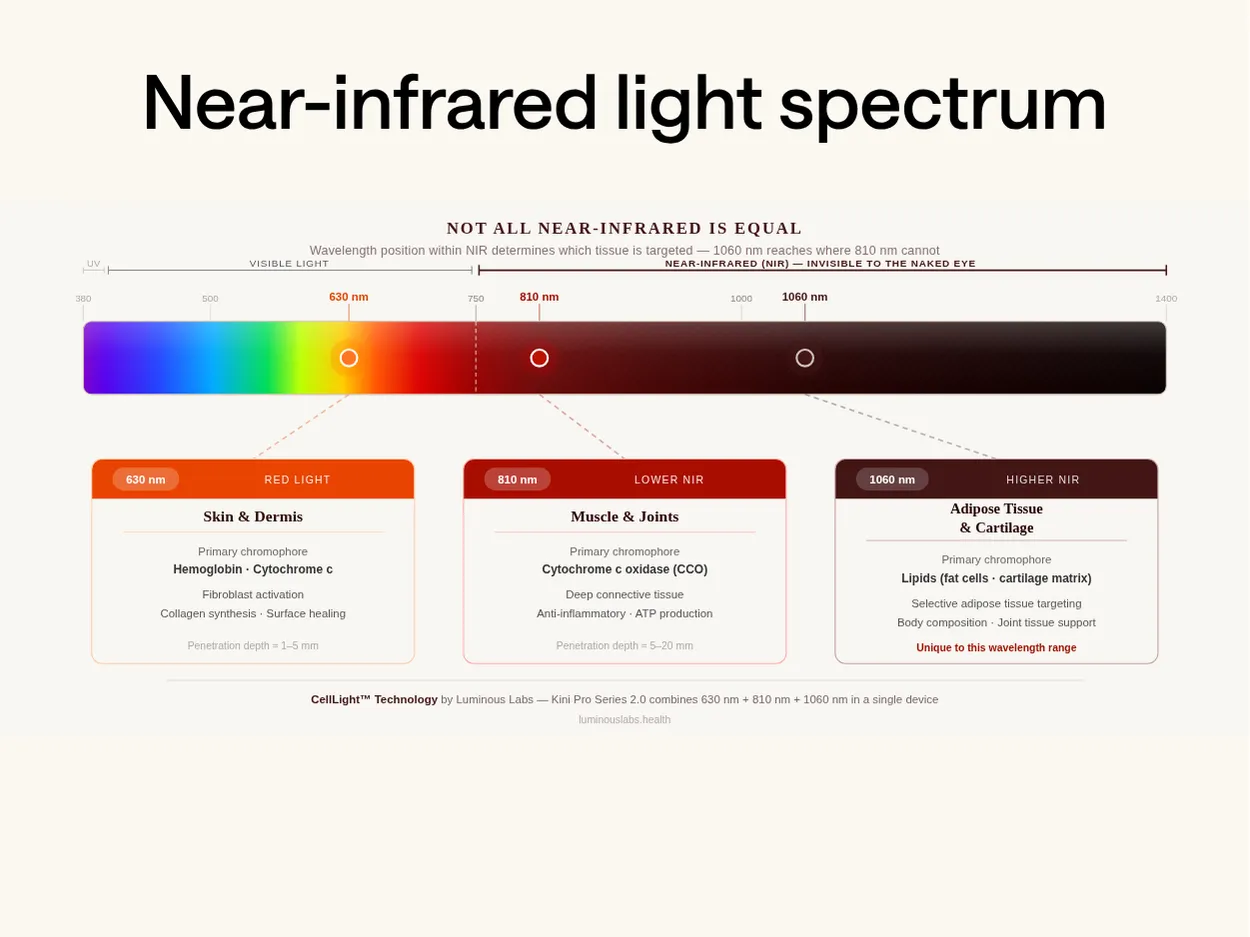
1060nm is also near-infrared. It sits in the same spectral family, NIR spans from approximately 750nm to 1400nm before transitioning into short-wave infrared. But within that range, wavelength determines which tissue is the primary target. And 1060nm has an absorption profile that 810nm does not replicate.
Not better. Not a different category of light. But different enough in its tissue interaction that it adds a clinical dimension the shorter NIR wavelengths simply cannot cover.
Why position within NIR determines tissue target
When light enters tissue, it is simultaneously scattered and absorbed. The relative balance between those two processes determines how far the light travels and which cellular structures it interacts with. Critically, different wavelengths — even within the same spectral family, encounter different absorption profiles in different tissue types. This is what drives clinical application decisions. [1]
Within the near-infrared range, 810–850nm is the most extensively studied wavelength for photobiomodulation. It has low water and haemoglobin absorption, travels well through soft tissue, and has strong evidence for muscle recovery, joint and anti-inflammatory applications. It is the workhorse of clinical NIR protocols.
At 1060nm, higher in the NIR range, the absorption landscape changes. Water absorption begins to rise, but lipids become a more prominent chromophore. This shift in the dominant absorber at the cellular level is what gives 1060nm its distinct tissue selectivity: it is preferentially absorbed by adipocytes and lipid-rich environments in ways that 810nm is not.
The key distinction:
1060nm and 810nm are both near-infrared. But within NIR, wavelength determines which chromophore is the primary absorber. At 1060nm, light has a selective affinity for lipid-rich tissue, a target that 810nm does not reach with the same specificity.
What 1060nm targets: adipose tissue and body composition
The most clinically documented application of 1060nm light is non-invasive fat reduction. A 2021 randomised study published in Lasers in Medical Science evaluated a combined 1060nm diode laser with 635nm low-level laser therapy on 42 subjects. After a single treatment session, ultrasound imaging at 12 weeks showed a statistically significant 18.62% reduction in abdominal fat and a 26.4% reduction in submental fat. Waist circumference decreased significantly and 96% of subjects reported satisfaction. [2]
The mechanism behind this is not thermal destruction of fat cells, it is photobiomodulation of adipocyte biology. At 1060nm, light is selectively absorbed by lipids. This absorption triggers intracellular signalling changes in adipocytes, including activation of mitochondrial chromophores, that affect how fat cells store and release lipids. The result is a non-invasive remodelling effect on subcutaneous adipose tissue that shorter wavelengths, with their lower affinity for lipid absorption, do not replicate.
This makes 1060nm specifically relevant for body composition protocols and for practitioners working with clients whose goals include not just skin quality or recovery but overall body remodelling alongside longevity.
What 1060nm targets: cartilage and joint tissue
A second distinct application of 1060nm-range light is in cartilage and joint biology. A 2023 study in the Journal of Biophotonics examined 1064nm Nd:YAG laser irradiation in cartilage tissue models. The findings showed that treatment increased collagen expression and stimulated chondrocyte proliferation, the cells responsible for cartilage maintenance and repair, through a photobiomodulation pathway involving upregulation of aromatase activity in local tissue. [3]
Cartilage is avascular it does not have a blood supply and receives nutrients through diffusion. This makes it a challenging tissue for conventional therapeutic approaches and a logical candidate for light-based interventions that work at the cellular level. The 1060nm-range absorption profile appears to have a specific affinity for the chondrocyte cellular environment in ways that have not been demonstrated at shorter wavelengths.
For protocols oriented toward joint health, mobility and longevity, particularly in active populations or older adults, 1060nm adds a tissue target that neither red nor standard NIR addresses.
What 1060nm targets: cytochrome c oxidase via a different pathway
The primary mechanism of photobiomodulation across all wavelengths is the activation of cytochrome c oxidase (CCO) ,complex IV of the mitochondrial electron transport chain. CCO has multiple absorption peaks across the red and near-infrared spectrum, and different wavelengths activate it through different absorption bands. [1]
A 2021 review in Lasers in Medical Science documented that 1064nm treatments have been validated in human studies for increasing blood oxygenation, blood flow, CCO concentration, and EEG power in the brain — confirming that CCO activation occurs at this wavelength through a distinct absorption pathway, not only through the primary peaks utilised by 630nm and 810nm. [4]
This has practical implications: for deep systemic applications, particularly where improved circulation, mitochondrial function and metabolic signalling are the target, 1060nm contributes a complementary CCO activation signal that broadens the photobiomodulation stimulus beyond what shorter wavelengths deliver alone.
How 1060nm fits into a protocol and why home access matters
Understanding what 1060nm does changes how it should be positioned within a protocol. It is not a replacement for 630–660nm or 810–850nm it is a complement. Each wavelength has a primary tissue target:
630–660nm (Red)
Primary target: skin, epidermis, dermis, fibroblasts. Applications: collagen synthesis, skin rejuvenation, wound healing, surface anti-inflammatory effects.
810–850nm (Lower NIR)
Primary target: muscle tissue, joints, deep connective tissue, mitochondria in high-metabolic-activity cells. Applications: muscular recovery, deep anti-inflammatory effects, performance.
1060nm (Higher NIR)
Primary target: adipose tissue, cartilage, lipid-rich cellular environments. Applications: body composition support, joint health, complementary CCO activation via selective lipid absorption.
Until recently, 1060nm was the exclusive domain of clinical laser devices, Nd:YAG lasers in medical settings, specialist body contouring equipment in clinics. The studies cited in this blog used devices that were not available outside a clinical or research environment. The protocol designs they validated, 1060nm combined with red light, applied to adipose and cartilage tissue, could not be replicated at home.
Pro Series 2.0 changes that. It is the first home device in its class to include 1060nm alongside 630–660nm and 810–850nm, meaning the three-wavelength protocol backed by the evidence above can now be applied consistently, at home, at the parameters the research supports. [2, 3, 4, 5]
This is not a marketing claim. It is a direct consequence of the wavelength range the device covers. When a study demonstrates 18.62% abdominal fat reduction using 1060nm combined with 635nm, the ability to replicate that study design at home, with the correct wavelengths, correct exposure parameters and consistent protocol, is what separates a home device from a home gadget.
See how red light supports your goals - explore the product benefits now.
The takeaway:
1060nm does not replace red or lower NIR. It completes the protocol, targeting adipose tissue and cartilage that the other wavelengths do not reach with the same specificity. What was previously only achievable in a clinic is now available as a home protocol. Three wavelengths. Three distinct tissue targets. One coherent system.
Frequently Asked Questions
What does 1060nm light therapy do?
1060nm near-infrared light selectively targets adipose (fat) tissue and cartilage, tissue types that red (630–660nm) and standard NIR (810–850nm) wavelengths do not reach with the same specificity. It also activates cytochrome c oxidase through a distinct absorption pathway, contributing to mitochondrial energy production and systemic cellular effects.
Is 1060nm the same as near-infrared (NIR)?
Yes. 1060nm is within the near-infrared spectrum, which spans from approximately 750nm to 1400nm. However, not all NIR wavelengths behave the same in tissue. 810nm and 1060nm are both NIR, but 1060nm sits higher in the range where lipid absorption becomes more dominant, giving it a different tissue selectivity profile compared to 810nm.
Can 1060nm light reduce fat?
Clinical evidence supports the use of 1060nm light for non-invasive reduction of subcutaneous fat. A 2021 study in Lasers in Medical Science demonstrated statistically significant reductions in abdominal fat (18.62%) and submental fat (26.4%) 12 weeks after treatment with a combined 1060nm and 635nm device in 42 subjects. The mechanism involves selective absorption by adipocytes and photobiomodulation of lipid metabolism, not thermal fat destruction.
What is the difference between 810nm and 1060nm near-infrared?
810nm is the primary NIR wavelength for muscle recovery, deep anti-inflammatory effects and mitochondrial activation in high-metabolic cells. 1060nm, higher in the NIR range, selectively targets adipose tissue and cartilage through its lipid absorption characteristics, a different tissue profile. Both have a role in a comprehensive protocol.
Does Kini Pro Series 2.0 include 1060nm?
Yes. Kini Pro Series 2.0 by Luminous Labs includes 1060nm alongside 630–660nm and 810–850nm, making it the first home device in its class to cover the full wavelength range used in clinical 1060nm research. This means the three-wavelength protocols validated in peer-reviewed studies can be replicated at home with the correct parameters.
References